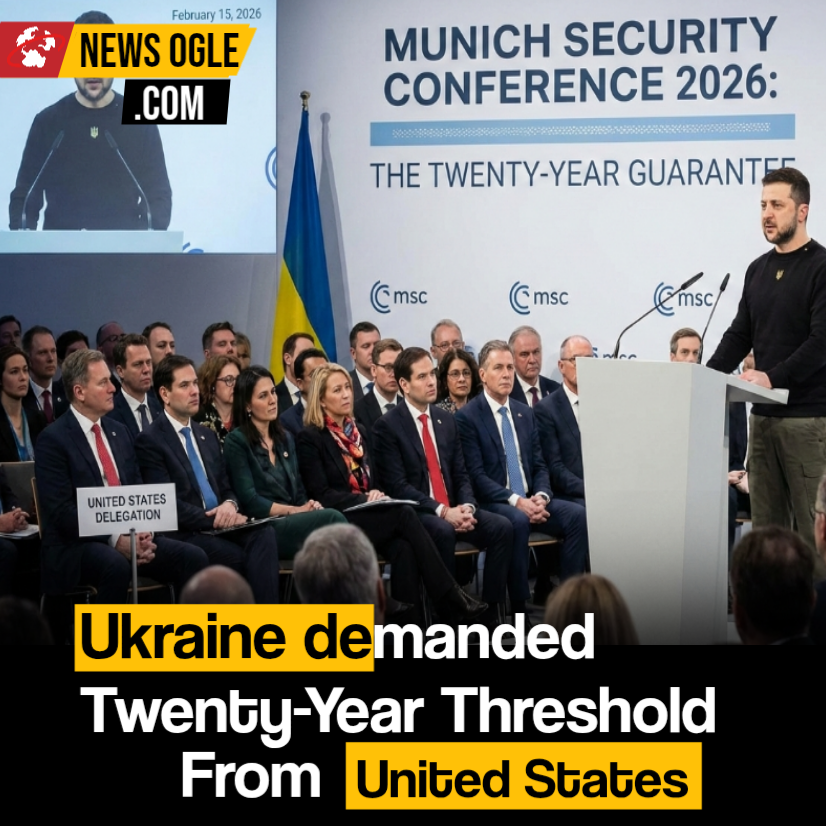
Munich, February 15, 2026 — As the snow fell over the Bayerischer Hof this weekend, the atmosphere inside the Munich Security Conference was anything but cold. It was electric, strained, and focused on a single, staggering number: twenty.
Ukrainian President Volodymyr Zelenskyy, appearing before a global audience of leaders and diplomats, laid down what may be the final, non-negotiable condition for ending the largest conflict in Europe since 1945. Ukraine, he declared, will not sign any peace deal with the Russian Federation without a legally binding, “water-tight” security guarantee from the United States spanning at least twenty years.
The demand comes at a pivotal moment. With the third round of trilateral talks between Kyiv, Moscow, and Washington set to begin in Geneva this Tuesday, February 17, the world is holding its breath. For the first time in four years of grinding, attritional warfare, the outline of a settlement is visible—but the distance between a “settlement” and a “surrender” lies in the fine print of American commitment.
The 15 vs. 20 Gap: More Than Just a Number
Reports from the conference indicate that the Biden-turned-Trump transition and the subsequent second Trump administration have already moved significantly. U.S. negotiators, led by Special Envoy Steve Witkoff and supported by Secretary of State Marco Rubio, have reportedly put a 15-year security protocol on the table.
To a casual observer, the five-year discrepancy between the U.S. offer and Ukraine’s demand might seem like diplomatic hair-splitting. To Kyiv, those five years represent the “danger zone” of a Russian resurgence.
“We are not looking for a pause,” Zelenskyy told a crowded press conference in Munich. “We are looking for a period long enough to rebuild our nation, integrate into the European Union, and ensure that our children do not have to fight this same war in 2040.”
The logic is rooted in the “Israel Model” but adapted for a European theater. Ukraine is seeking a commitment that outlasts at least four U.S. election cycles, providing a hedge against the shifting winds of American isolationism. A 20-year window takes Ukraine through its projected 2027 EU accession and deep into a decade of reconstruction, effectively making it a permanent fixture of the Western security architecture before the guarantee expires.
The “European Reassurance Force” and the New Article 5
Central to the 20-year demand is the “European Reassurance Force” (ERF). Unlike the toothless observers of the past—the failed OSCE missions or the ignored Budapest Memorandum of 1994—the ERF is envisioned as a “Coalition of the Willing” with boots on the ground.
As outlined in the “Paris Declaration” signed just last month, this force would consist of troops from the UK, France, Poland, and the Baltic states. They would not be combatants in the current war, but “guarantors of the peace,” stationed along the line of contact to ensure that a ceasefire remains a ceasefire.
However, the Europeans are clear: they will not deploy without a U.S. “backstop.” Ukraine’s demand for a 20-year U.S. guarantee is specifically designed to pin Washington as the ultimate deterrent. If Russia attacks the ERF or breaches the peace, the U.S. commitment would trigger an “Article 5-like” response—reinstating all global sanctions, providing immediate “qualitative military edge” (QME) weaponry, and potentially involving U.S. logistical and aerial support.
The Ghost of the Budapest Memorandum
To understand why Zelenskyy is being so “inflexible,” as some in Washington have whispered, one must look at the scars of 1994. In the Budapest Memorandum, Ukraine surrendered the world’s third-largest nuclear arsenal in exchange for “security assurances” from the U.S., UK, and Russia. When Russia invaded Crimea in 2014 and launched the full-scale invasion in 2022, those “assurances” proved to be worth less than the paper they were written on.
“We were told that signatures meant safety,” said one senior Ukrainian advisor in Munich. “We learned that only steel and legally binding domestic law in the guarantor countries mean safety. This time, the agreement must be ratified by the U.S. Congress. It must be a treaty, not a memorandum.”
This is the “watertight” nature Zelenskyy referred to. By demanding a 20-year framework ratified by Congress, Ukraine is attempting to bypass the “policy by tweet” era, ensuring that any future U.S. president would find it legally and politically difficult to walk away from Kyiv.
The Trump Factor: Peace by June?
The backdrop to these negotiations is the intense pressure from the White House. President Donald Trump, having returned to office in January 2025, has made no secret of his desire to “get moving” on a deal. Sources suggest the U.S. is pushing for a finalized agreement by June 2026, allowing Trump to claim a massive foreign policy victory ahead of the U.S. midterm elections.
This has created a delicate dance. While Trump’s team has floated a “Prosperity Plan” that would involve U.S. companies gaining preferential access to Ukraine’s vast mineral resources—including lithium and rare earth metals in the East—Kyiv is using that economic leverage to extract harder security terms.
“The Americans talk about investment; we talk about survival,” Zelenskyy noted pointedly. “We are ready for a prosperity partnership, but prosperity requires a foundation of peace that won’t crumble in ten years.”
The administration’s “transactional” approach to foreign policy is visible here. Secretary Rubio has framed the U.S. role as “rebuilding the world order,” but warned that the U.S. would “go it alone” on issues like trade and migration if Europe doesn’t step up. For Ukraine, the 20-year guarantee is the price Washington must pay for the “Prosperity Plan” and for the stability that allows the U.S. to pivot its focus toward the Indo-Pacific.
The Sticking Points: Donbas and the Energy Siege
While the duration of security guarantees is the headline issue, the reality on the ground in Ukraine remains dire. Not a single energy plant in the country has been left unscathed by Russian strikes. As the Geneva talks loom, Russia has intensified its “energy siege,” using the new “Oreshnik” ballistic missiles to signal its capacity for further escalation.
The territorial question also remains a chasm. The U.S. has reportedly suggested that if Ukraine withdrew from certain parts of the Donbas, a ceasefire could be reached “as quickly as possible.” Zelenskyy’s response in Munich was a flat rejection: “We cannot withdraw from where Ukrainians live. To do so would be to invite the same ‘denazification’ and ‘filtration’ we have seen in Mariupol and Bucha.”
Instead, Ukraine’s 20-point peace plan (unveiled Christmas 2025) proposes a “Free Economic Zone” in the disputed areas, overseen by international monitors, where the de facto front line is recognized but not the de jure sovereignty of Russia. It is a “freeze” rather than a “cession,” a bitter pill that many Ukrainians are only willing to swallow if—and only if—the 20-year U.S. shield is locked in.
The “Ironization” of Russia and the Long Game
There is a growing sense among European leaders, including UK Prime Minister Keir Starmer and French President Emmanuel Macron, that Vladimir Putin is not yet exhausted. While the Russian economy is showing signs of “Iranization”—highly sanctioned, military-focused, and increasingly dependent on Beijing—it is not on the verge of collapse.
European intelligence suggests Russia could reconstitute its forces for a new offensive within two years of a ceasefire. This is the “nightmare scenario” that drives the 20-year demand. A 15-year guarantee might expire just as a rebuilt Russian war machine feels ready for “Round Two.” A 20-year guarantee, however, provides the breathing room for Ukraine to become a “steel porcupine”—a nation so well-armed and integrated into the West that the cost of a new invasion would be suicidal for the Kremlin.
The Iranian Shadow
Zelenskyy’s speech also took a sharp turn toward Tehran. The sheer volume of Iranian Shahed drones—now numbering in the thousands per month—has crippled Ukraine’s infrastructure. In Munich, amid massive protests calling for the toppling of the Iranian regime, Zelenskyy linked the security of Ukraine directly to the global “axis of destabilization.”
By demanding long-term U.S. guarantees, Ukraine is also asking for a long-term commitment to counter the technology transfers between Russia, Iran, and North Korea. This isn’t just a border dispute; it is a laboratory for 21st-century warfare, and Ukraine refuses to be the test subject for another two decades without a protector.
The Path to Geneva: What Happens Next?
On Tuesday, when the delegations meet in Switzerland, the “20-year” figure will be the ghost at the table. If Washington agrees to the extension, it will signal a fundamental shift in American grand strategy—a return to long-term European “entanglement” that many thought was a thing of the past.
If Washington holds firm at 15 years, or continues to push for immediate Ukrainian concessions in the Donbas without a “watertight” legal framework, the talks may stall. For Zelenskyy, the risk of no deal is high, but the risk of a bad deal is terminal.
“No one chose to be a hero,” Zelenskyy said as he closed his Munich address. “We chose to be a country. And a country is not something you trade for a few years of quiet. We want a peace that our grandchildren will thank us for, not a ceasefire they will have to die for.”
Conclusion: The Architecture of Peace
Two thousand words can barely scratch the surface of the suffering endured by Ukrainians over the last 1,453 days. But as the diplomats pack their bags for Geneva, the technical details are all that remain.
The 20-year US security guarantee is more than a legal clause. It is a statement of intent. It is the bridge between a continent at war and a continent at rest. If the United States can find the political will to commit for two decades, the “moment of truth” in 2026 might finally lead to the silence of the guns. If not, the “slave to war” in the Kremlin will simply wait for the clock to run out.
For Ukraine, twenty years is the price of dignity. For the world, it might be the price of peace.
Key Elements of the Proposed 20-Year Deal:
- Article 5 Mirror: Immediate reinstatement of all “Global Sanctions” if the ceasefire is breached.
- QME (Qualitative Military Edge): A commitment to provide Ukraine with weaponry superior to Russia’s for 20 years.
- European Reassurance Force: 10,000–20,000 European troops stationed in Ukraine as a “tripwire” force.
- Prosperity Package: $200 billion initial reconstruction fund, funded by seized Russian assets and private U.S. investment in Ukrainian minerals.
- EU Accession: A “fast-track” date of 2027 for full membership, with the U.S. guarantee acting as the bridge.